About FlowWays · Updated September 2026

The engineer
behind it.

Santiago Vargas Borja is a mechanical engineer and the founder of FlowWays. Engineering taught him to break a hard problem into parts, measure it, and fix it for good. We work the same way: find what costs you time, then solve it.

Scroll

01

Experience

Engineering work first, then the campus jobs I held alongside the degree.

2026 to Present

Unified Door and Hardware

Manufacturing Layout Engineer · Listing

I turn drawings into steel: hollow metal doors and frames, opening by opening. I read architectural and shop drawings, measure off the CAD, and specify where every piece of hardware preps into the door or frame. Those measurements feed the system writing the machine programs for bending and cut-outs. Every prep has to be right before release, because a wrong dimension is caught in fabricated steel, not by software.

Key work

  • Learned the listing software fast enough to now train new hires on it.
  • Built the department head an error-tracking tool: Python reads the shared mailbox, separates real job-release mistakes from follow-up replies, and logs one row per incident in a live workbook. It replaced a weekly report made by hand.

2023 to 2025 New York, NY

PJ Mechanical

Project Management Intern

Supported MEP construction projects at a consulting engineering firm: schedules, submittals, technical documentation and deliverables.

Key work

  • Reviewed mechanical drawings and specifications against building-system requirements.
  • Tracked milestones across several projects at once, coordinating engineers, project managers, contractors and field crews on execution, field checks and schedule.
  • Saw HVAC, piping, mechanical equipment and energy-efficiency measures installed on commercial buildings.

2025 to 2026 Bronx, NY

Manhattan University

Mailroom Student Employee

  • Processed and distributed hundreds of packages a day, keeping inventory and tracking records accurate.
  • Helped management with scheduling, onboarding and daily operations.

2022 to 2023 Bronx, NY

Manhattan University

Tour Guide, Admissions

  • Represented the university at admissions events, orientations, open houses and campus visits.
  • Answered questions from prospective students and families: where I first learned to explain technical things plainly.
02

Education

2022 to 2026 Riverdale, NY

Manhattan University

B.S. Mechanical Engineering · May 2026

Relevant coursework

Thermodynamics · Fluid Mechanics I–II · Heat Transfer · Machine Design · Finite Element Analysis · Manufacturing Processes · Mechanical Vibrations · Mechatronics · Control Systems Design · Solar System Design & Energy Management

03

Engineering & projects

My own work from the degree and outside it, not FlowWays client work.

2025 to 2026 Team project

A campus-scale solar plan, costed and defended

U.S. Department of Energy Solar District Cup · Mechanical engineering team member

  • Three real sites, three different problems on the Bronx campus. The gym roof already pitches 6.5°, so the array sits at 16.5°. The parking garage runs flat at 10°, and the empty lot needs soil testing before anything is ground-mounted.
  • 3,096 panels, 1,431,772 kWh a year across 12,986 m² of array: 139% of the gymnasium’s consumption and 161% of the garage’s.
  • Specified to the part number: Heliene 132HC TOPCon N-type modules (515–535 W, 22.5% efficiency) on CPS 100 kW / 480 V / 1500 Vdc string inverters, with combiners, disconnects, optimizers and transformers sized per site.
  • Costed against the real bill: 16.9 GWh a year of campus load at the Bronx rate of 30¢/kWh, with the investment tax credit, labor at 30% of install, a PPA at $0.12/kWh escalating 3% a year, O&M at $6.50/kW-yr and a 13.3% capacity factor. $4.4 M in, about six years to payback, $5.67 M over thirty.
  • Liaison between the mechanical and electrical teams, coordinating technical presentations, one-line diagrams and construction documents.

Spring 2026 Abaqus/CAE

Building the model so the mesh behaves

Finite Element Analysis · Native geometry project

  • Geometry built native. Parts modeled directly in Abaqus/CAE from dimensioned sketches rather than imported, so the feature tree stays editable.
  • Solids are partitioned on purpose, split along planes chosen to let the part mesh with structured elements instead of a degenerate free mesh.
  • Loads and BCs defined by surface set, so the load case swaps out without rebuilding the model.
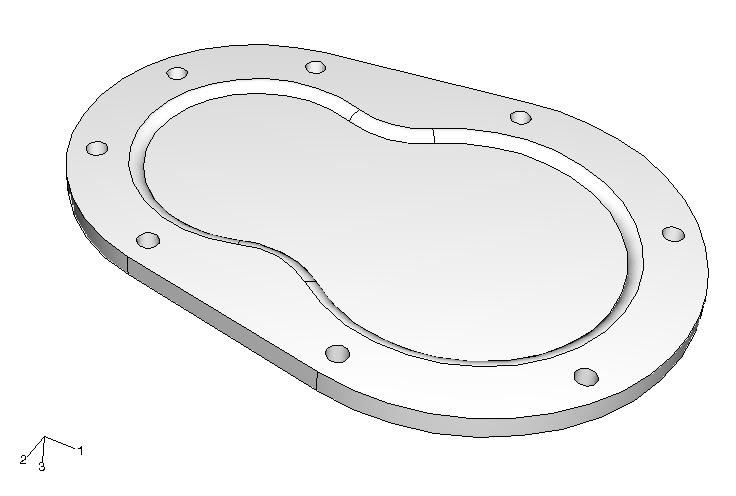
Flanged elliptical cover plate modeled as native geometry
Native geometryFlanged cover built inside Abaqus/CAE. No imported solid, so the feature history stays editable.
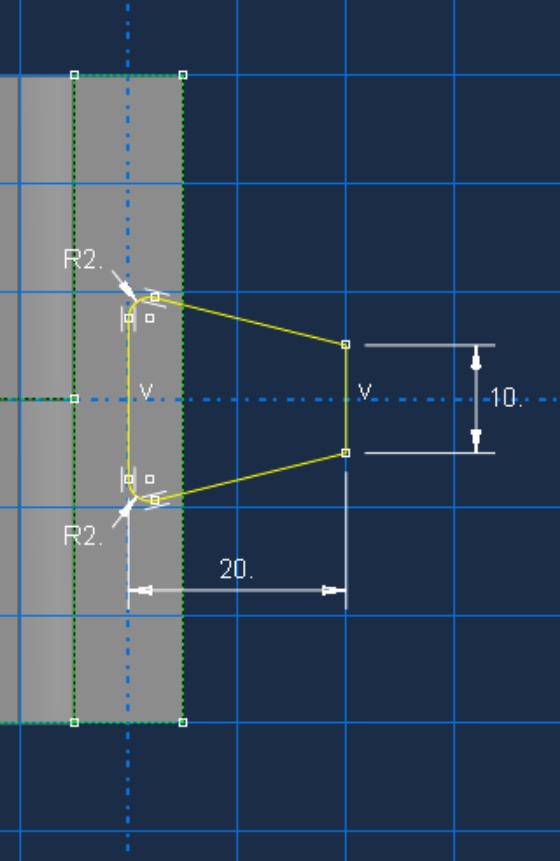
Dimensioned 2D sketch with R2 fillets driving an extrude
Parametric sketchR2 fillets and driven constraints on a dimensioned profile, so changing one number rebuilds the part.
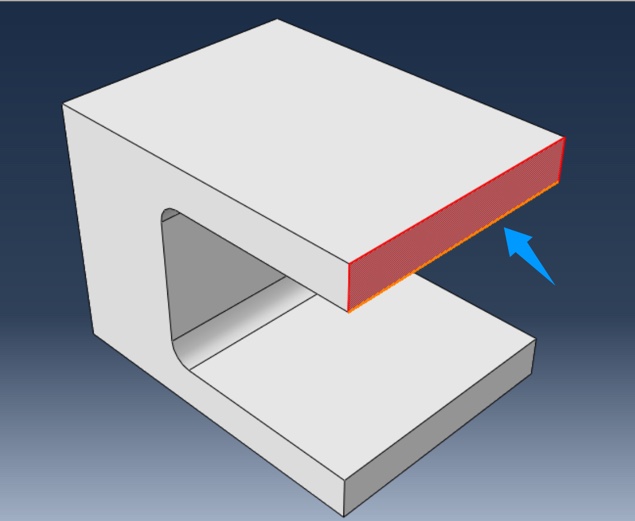
Cantilever bracket with a load applied to the free end face
Load caseLoad applied to the free end of the cantilever, defined against a named surface set rather than picked geometry.

Spring 2026 MECH 482

Modeling a solar water heater on a real roof

Solar Energy System Theory & Design · Manhattan University

  • A real building, real weather. A flat-plate collector on the Draddy Gymnasium roof, driven by hourly NREL National Solar Radiation Database data (direct, diffuse and global irradiance, ambient temperature, wind), not a design-day assumption.
  • Fixed physical parameters: 2 m² collector, 20° tilt facing south, 0.03 kg/s flow, 14 °C inlet, heat-removal factor 0.86, loss coefficient 7 W/m²·°C.
  • Two operating strategies compared, single-pass against recirculating, with flow shut off whenever useful gain went negative so the model never cooled the tank it was heating.
  • Built from the energy balance, Qu = FR[S − UL(Tin − Ta)], with outlet temperature from Tout = Tin + Qu/ṁcp, solved hourly across the year in Excel.

Spring 2026 MECH 442

Predicting building energy efficiency from HVAC data

Artificial Intelligence Applications in Mechanical Engineering · Manhattan University

  • 52,560 hourly records, 21 features (cooling, heating, pump and fan electricity, outdoor air temperature, humidity and air mass flow), classified into low, standard and high efficiency.
  • Three algorithms compared under stratified 10-fold cross-validation: logistic regression at 88.1%, k-nearest neighbors at 90.2%, and a tuned decision tree at 99.0%.
  • Judged on more than accuracy. Precision, recall, F1, AUC, MCC and confusion matrices, with hyperparameter tuning to hold overfitting down.
  • The feature ranking put HVAC, pump and cooling electricity on top: the same systems I’d spent two years around on site at PJ Mechanical.

April 2026 MECH 330

The design of the experiment was the work

Thermal & Fluid Laboratory · Manhattan University

  • Wax type, candle geometry and airflow crossed in every combination: a full factorial, not one variable at a time. 16 runs, each replicated, so interactions were measured, not assumed.
  • The controls are the experiment. Tea-light casings weighed and subtracted from every reading, wicks trimmed to 5 mm and pre-burned to a steady flame, fan fixed at three feet, room sealed against draft.
  • Multi-way ANOVA in SPSS. Geometry dominated (F = 1793, p < .001). Wax type and airflow were significant but secondary. Both interacted with geometry, so neither effect holds constant across candle diameters.
  • Uncertainty was propagated properly: root-sum-of-squares from the instrument limits (±0.05 g on the scale, ±0.5 s on the timer) gave ±1.81% on the burn rate, and showed the measurement was scale-limited, not timing-limited.
  • The key finding was negative. Melt-pool size, the visible part, turned out not to track burn rate at all. Only mass loss did.

Personal project Python

A pipeline to do the digging

My own tool · Public property records

A multi-stage Python pipeline I built over public property records. It cleans and cross-references them, scores every result against the key numbers, then hands back a ranked shortlist.

04

Capabilities

Engineering

  • Onshape
  • Revit
  • AutoCAD
  • Abaqus
  • Finite Element Analysis
  • HVAC & building systems
  • Mechanical design
  • Technical documentation

Manufacturing

  • Hollow metal doors & frames
  • Shop drawing takeoff
  • Hardware preps
  • CNC program generation
  • Listing process

Software

The tools behind the websites and automations, for anyone who wants the technical detail. You don’t need to know any of them to work with us.

  • Python
  • JavaScript / TypeScript
  • MATLAB
  • SQL
  • Next.js
  • React
  • Prisma
  • Stripe
  • Docker
  • Vercel
  • n8n

Languages

  • English: fluent
  • Español: nativo

05

Recognition

Manhattan University

Dean’s Award, top 25% of applicants

Manhattan University

Sportsmen for Charity Endowed Scholarship

Certification

OSHA 30

Activities

ASME · AIAA · SHPE · Delta Kappa Epsilon

06

The team

FlowWays is run by Santiago Vargas Borja, founder, and Edward Eguia, co-founder, who leads client communication.

FlowWays

Edward Eguia

Co-founder · Client communication

Ed handles the calls, the follow-ups and FlowWays’ own public relations and social media. Every project starts with Ed and Santiago talking the idea through. His background is in technology and social media.

Available for new projects · New York & remote

Have a project
in mind?

Tell us what the business needs, and we’ll tell you straight whether we’re the right fit.